
Global Ensemble Fire Emission (EnsemFire)
What is EnsemFire?
Vegetation fires, from both wildland and cropland, impose profound impacts on human health and welfare. Quantification of fire emission is important to understand these impacts. Many fire products, however, exist, with large differences in emission estimates among them. These large differences leave users puzzled which one to choose and how big the uncertainty is.
The Global Ensemble Fire Emission Product (EnsemFire) is an ensembled fire emission dataset developed and maintained by the Center for Satellite and Earth Science Studies at George Mason University, in collaboration with University of Texas at Arlington and several United States and international partners. EnsemFire provides the ensemble mean of fire emissions from seven popular fire products. Variables include global daily records of fire radiative power (FRP) and emissions of nine key air pollutants: fine particulate matter (PM2.5), black carbon (BC), organic carbon (OC), carbon monoxide (CO), carbon dioxide (CO2), ammonia (NH3), nitrogen oxides (NOx), sulfur dioxide (SO2), and methane (CH4).
How Is EnsemFire Generated?
The ensemble mean FRP at a given grid (; unit: MWatt) is calculated as:
where is the FRP value from emission inventory while represents the number of available emission inventories at grid (e.g. if all inventories are included).
For fire emissions, the ensembled daily total fire emission of species (i.e. PM2.5, BC, OC, CO, CO2, NH3, NOx, SO2, and CH4) at a given grid (; unit: kg) is calculated as:
where is the emission rate (ER) of species from emission inventory , represents the number of available emission inventories, and is the surface area at grid . Total seconds per day (86400 s) is applied to retrieve daily emissions.
More details of the ensemble emission method can be found in Li et al., (2025) (link: https://www.nature.com/articles/s41597-025-06429-z).
Table 1. Information for the seven biomass burning emission datasets used in EnsemFire V1.0.
| Dataset | GFAS | FINN | QFED | FEER | GBBEPx | EPA | CFFEPS |
| Agency | CAMS | NCAR | NASA | NASA | NOAA | US EPA | ECCC |
| Version | 1.2 | 2.5 | 2.6 | 1.0 | 4, 5* | – | 2.03, 2.06** |
| Spatial resolution | 0.1 | 0.1 | 0.1 | 0.1 | 0.1 | Point | Point |
| Spatial coverage | Global | Global | Global | Global | Global | North America | North America |
| Data period | 2003 – Nov 2025 | 2002 – Present | 2000 – Present | 2003- Present | 2012 – Present | 2002 – 2021 | 2016 – Present |
*GBBEPx v5 since May 2, 2024
** CFFEPS v2.06 since 2021
Downloads
EnsemFire daily products are available in NetCDF format. Each daily file obtains individual FRP and 9 fire emissions (PM2.5, BC, OC, CO, CO2, NH3, NOx, SO2, and CH4) from emission inventories, as well as the ensemble products. All datasets are interpolated to a unified 0.1 degree global coordinate.
- The latest publicly available EnsemFire (EnsemFire v1.0), released in early 2026, includes datasets from 2012 to 2021: https://doi.org/10.6084/m9.figshare.29642135
- Datasets from 2022 to 2025 are available per request.
Contact Information:
Yunyao Li
Wei-Ting Hung ([email protected])
Daniel Tong ([email protected])
Examples
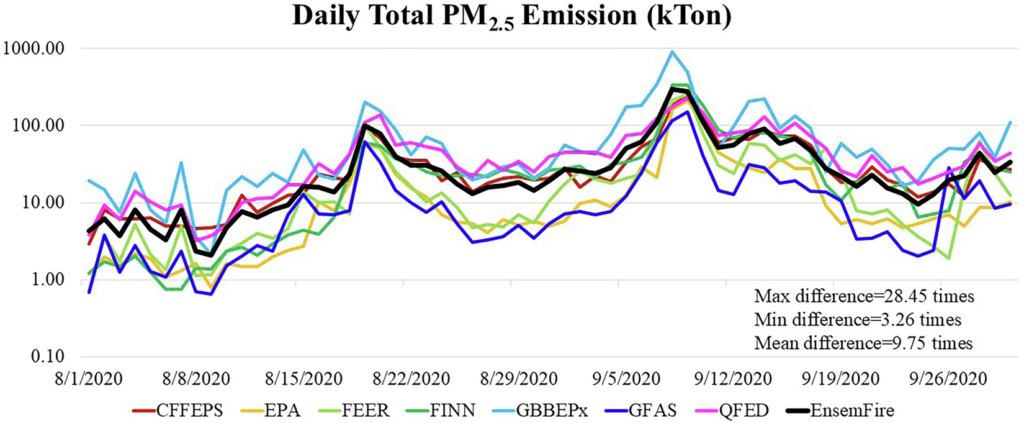
Daily PM2.5 total emissions for the western U.S. during the 2020 wildfire season
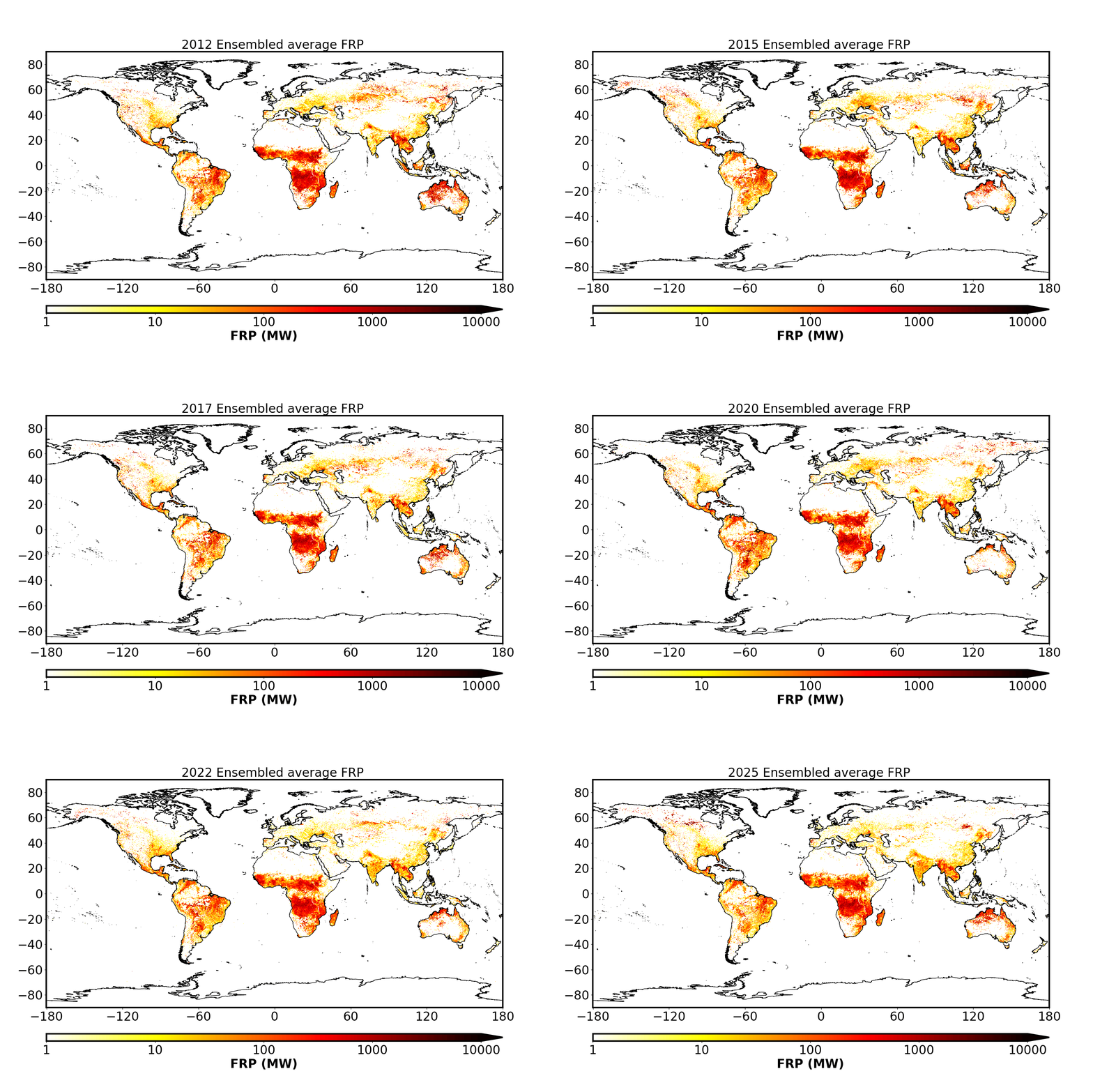
Ensemble mean FRP in 2012 – 2025
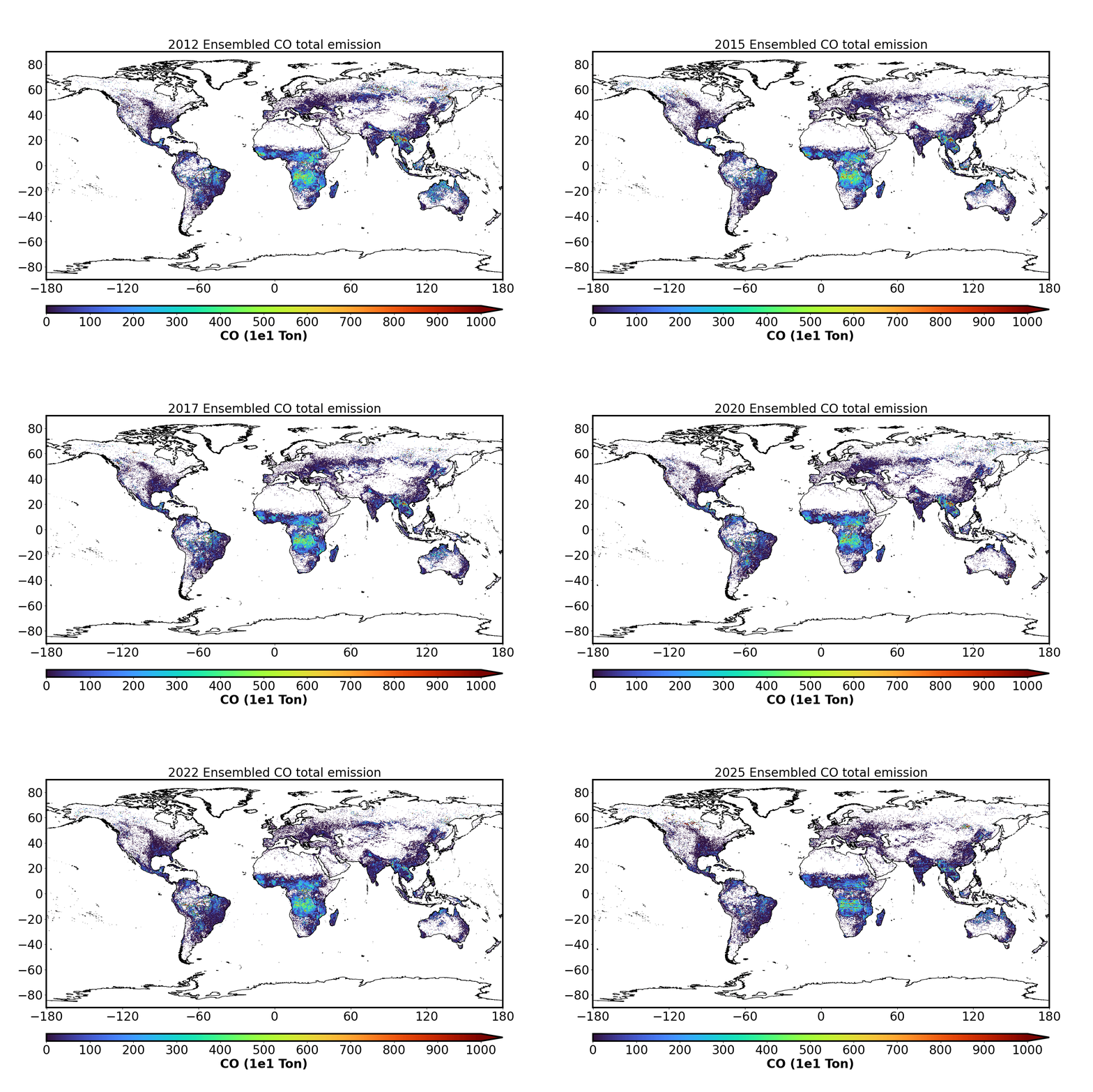
Ensemble mean CO emission in 2012 – 2025
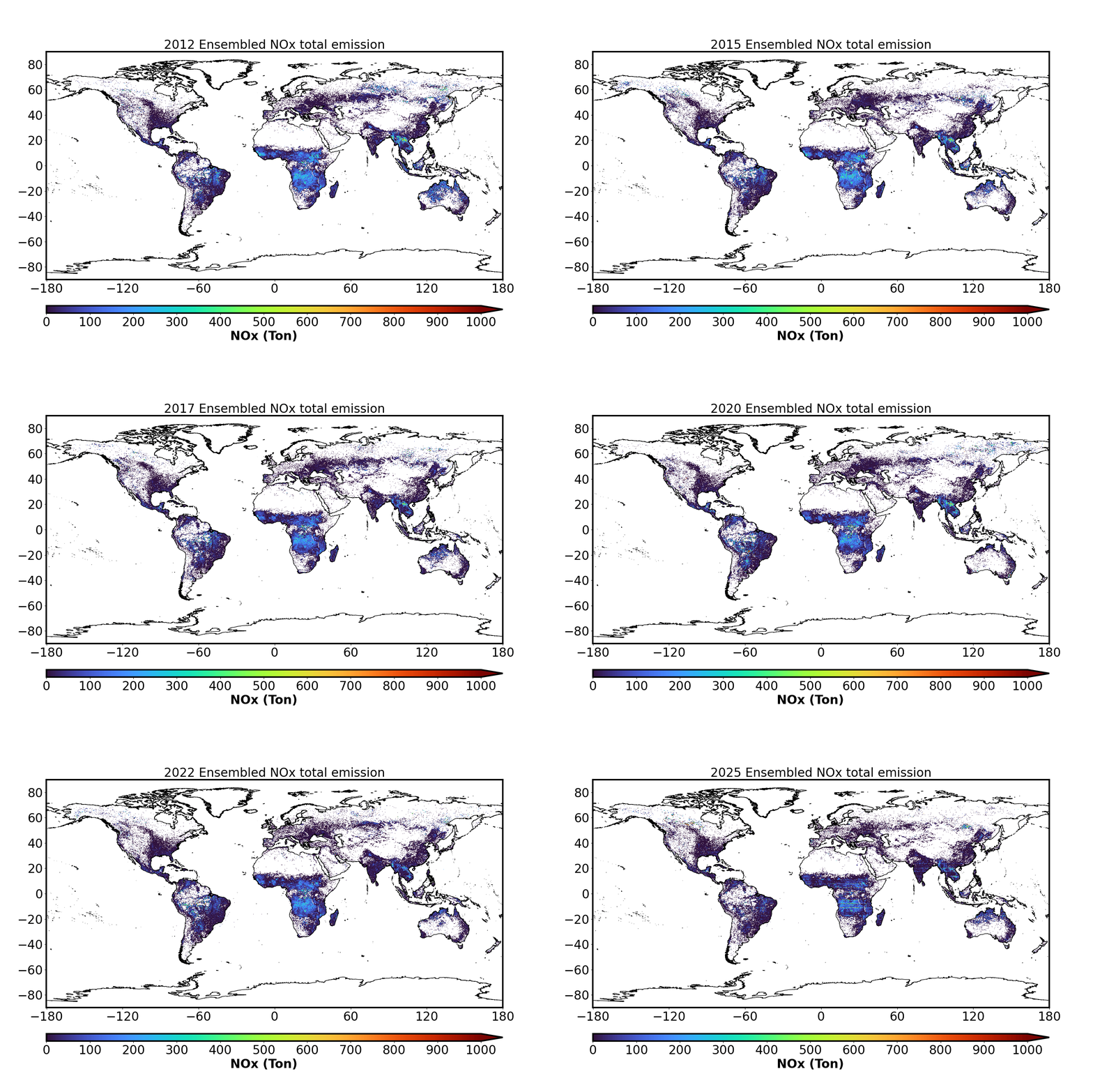
Ensemble mean NOx emission in 2012 – 2025
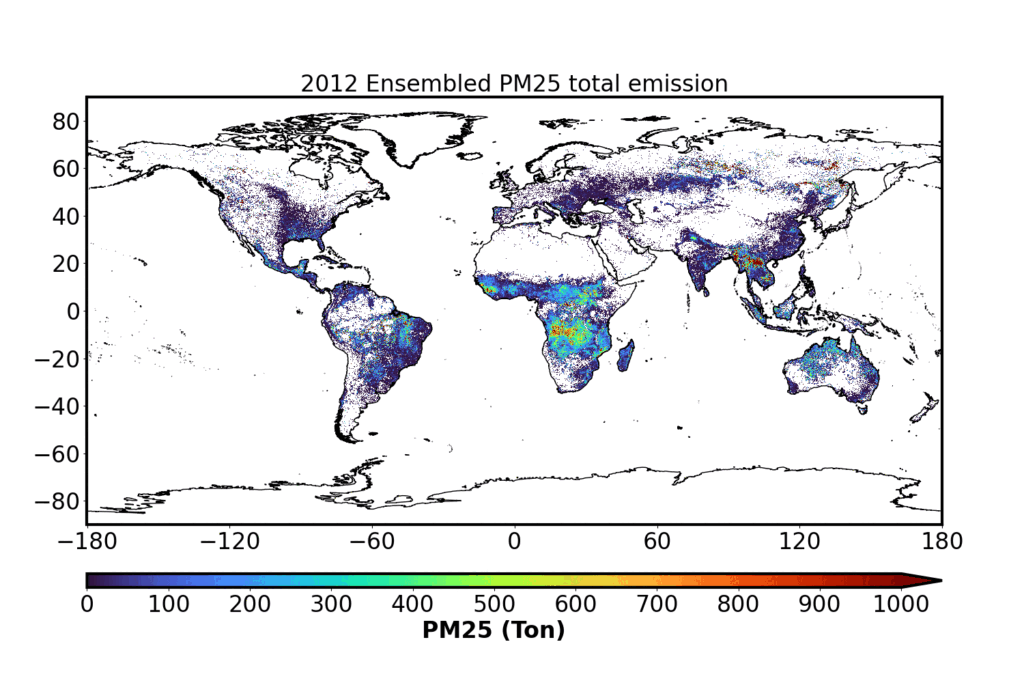
Ensemble mean PM2.5 emission in 2012 – 2025
Publications
Li, Y., Tong, D., Sun, Z., Zhang, L., Ferrada, G., Sun, S., Zhang, X., Chen, J., Ichoku, C., Darmenov, A., 2026a. Global Ensemble Fire Emission Product Version 1.0 (EnsemFire V1.0). Sci Data 13, 117, doi: 10.1038/s41597-025-06429-z.
Acknowledgement
This work is supported by NOAA Weather Program Office (WPO) grants NA23OAR4590388, NA23OAR4590387, and the NOAA Cooperative Agreement NA22OAR4320151. We thank the US EPA for providing the national emissions inventories, NOAA for providing the GBBEPx data, NCAR for the FINN data, ECMWF for the GFAS emission data.